Why enterprise AI agents fail and what failed runs cost
Learn why enterprise AI agents fail, how to diagnose the cause, and how to calculate cost per completed workflow including retries and human intervention.
Ideas, field notes, and product updates from Monarch.
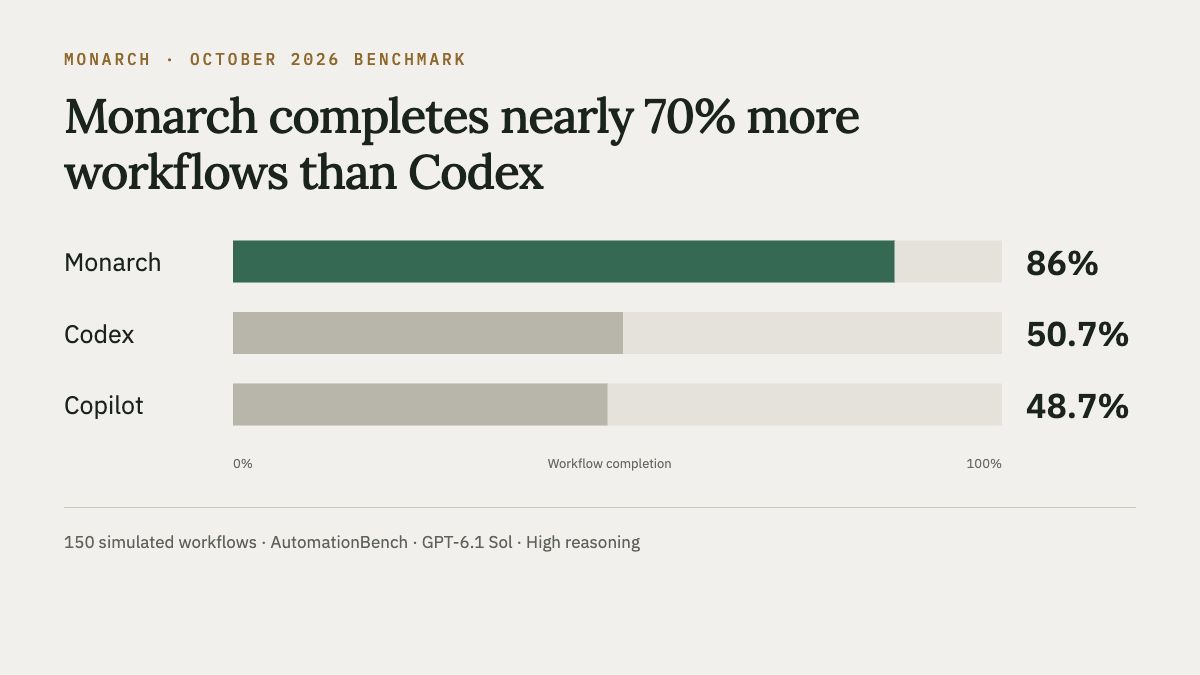
Benchmark results: Monarch completed 129 of 150 workflows to Codex’s 76 using the same model and reasoning level. See completion and model costs.

An agent security reference architecture: Sandboxed processes, LLM gateways, observability, forward proxies, and content inspection.

Get better results from the same AI model by improving how it’s used.
No articles match these filters. Clear a filter to see more.
Learn why enterprise AI agents fail, how to diagnose the cause, and how to calculate cost per completed workflow including retries and human intervention.
Compare Workato, Monarch, Composio, and Merge Agent Handler, then separate integration needs from the choice to build with Microsoft, Google, OpenAI, or Claude.
See how AI agents can use authorised private web interfaces and UI paths in legacy systems, with an application map, approval steps, and verified results.
An application map connects records, actions, permissions, and validation checks so AI agents can execute workflows with explicit business rules.
An agent security reference architecture: Sandboxed processes, LLM gateways, observability, forward proxies, and content inspection.
Benchmark results: Monarch completed 129 of 150 workflows to Codex’s 76 using the same model and reasoning level. See completion and model costs.
Well then, how much better can an AI agent get without a better model nowadays?
How we built a mainframe playground and vibecoded in COBOL.
Practical safeguards for AI workflows: Permissions, protected credentials, deterministic actions, monitoring, and testing before production.
Why mainframes still power demanding business workloads, and how AI agents can work with their integrations and terminal applications.
What OpenAI’s non-engineering teams suggest about enterprise work over the next three years.
An AI workflow needs someone accountable for its results after launch, with the time, evidence, and authority to keep improving it.
Sam Senior, Michael Schniering of BCG X, and Claire Smith on what separates the companies getting returns from AI. Full video and transcript.
A connector logo does not mean your agents can finish the work. Expect deeper application discovery, reusable execution, and people leading the business change.
Microsoft's AI products serve different roles. See how Monarch discovers application operations and runs cross-system agentic workflows alongside your existing stack.
AI adoption requires changes to people’s workloads, incentives, and responsibilities. Give them time to improve the work and authority to lead the agents doing it.
An insurer's AI workflow should connect the policy, repair estimate, and claim history, then help the team complete the next action with the customer properly informed.
A useful banking agent connects the customer's request, account history, and existing support arrangement, then helps the team carry its decision into the systems that administer the loan.
Rebooking leaves work across hotel suppliers, ground transport, and case systems. Start with one overnight assistance workflow and verify every arrangement.
Follow an agent's authority from the requesting user through connected accounts, business approval, execution, and removal of the access it creates.
Follow a supplier change request through custom fields, related records, and approval rules, then verify exactly what the ERP has saved and submitted.
Compare how agents reach application actions, what gets reused and repaired, and how each approach proves the work actually happened.
Compare supported queries and writes, curated tools, and application discovery through a workflow that takes a held order to an approved release.
Build one useful business operation, establish its permissions and completion checks, then choose how your agent will call it.
Compare authorised tool execution, custom application work, and deployment choices, then test the complete workflow your team needs to run.
Compare application access, authentication, and workflow ownership, including the work needed when a required action sits outside a ready-made tool.
A useful energy workflow connects the complaint, account, metering evidence, and reviewer. Prove that investigation before expanding into financial actions.
Compare how Monarch and UiPath connect existing agents to enterprise systems, reuse automations, and keep control of work across applications.
Most enterprises use AI to run a slightly faster version of the company they already have. The bigger move is to rebuild how it works while it keeps running at full speed.
An accepted broadband order can still leave a customer without service. Recovering it means following the work through provisioning, inventory, and billing, then proving the records agree.
Carry an approved departure through access removal, work handover, and records preservation, with evidence of what each system actually completed.
An enterprise AI ontology is the map that lets agents operate your business. Most of it already lives in your software. Discover it, don't rebuild it from memory.
Follow a late purchase-order line from a supplier's revised promise through split deliveries, production decisions, and actual receipt.
Follow an invoice discrepancy through purchasing, receipts, supplier correspondence, and AP, then verify that the approved correction reached the records that control payment.
MCP makes connecting agents to your systems easy — not dependable. Why it is the wrong default for enterprise workflows, and what to run instead.
Google already supplies models, workplace AI, connectors, and agent infrastructure. Compare the application access your workflow still needs.
Define which cases enter the pilot, what counts as a useful result, and how you will compare it with today's operation before the first live run.
Compare how Workato and Monarch make enterprise application operations available to AI agents, and test the maintenance work behind a complete workflow.
We ran 591 AutomationBench workflows with and without Monarch. Opus 5's completion rate rose 23%; GPT-5.6 Sol and Kimi K3 improved too.
Compare the same frontier models with existing or custom tools and with Monarch, including the application work your team must build and maintain.
Compare Workato, MuleSoft, Automation Anywhere, and Monarch on workflow completion, agent capabilities, total cost, and Australian deployment requirements.
Learn why enterprise AI agents fail, how to diagnose the cause, and how to calculate cost per completed workflow including retries and human intervention.
Compare Workato, Monarch, Composio, and Merge Agent Handler, then separate integration needs from the choice to build with Microsoft, Google, OpenAI, or Claude.
See how AI agents can use authorised private web interfaces and UI paths in legacy systems, with an application map, approval steps, and verified results.
An application map connects records, actions, permissions, and validation checks so AI agents can execute workflows with explicit business rules.
No articles match your search. Try a broader term or clear the search.